

Primary
Define one whole unit
Represent one unit with a strip divided into ten equal parts. Each part is 0.1, so three parts represent 0.3.
Compare using the same unit
Compare 0.5 and 0.35 using equal wholes split into hundredths. Fifty hundredths is greater than thirty-five hundredths.
Check meaning before calculating
Choose a measurement or capacity example and ask what part of the unit each decimal represents. Always include units.
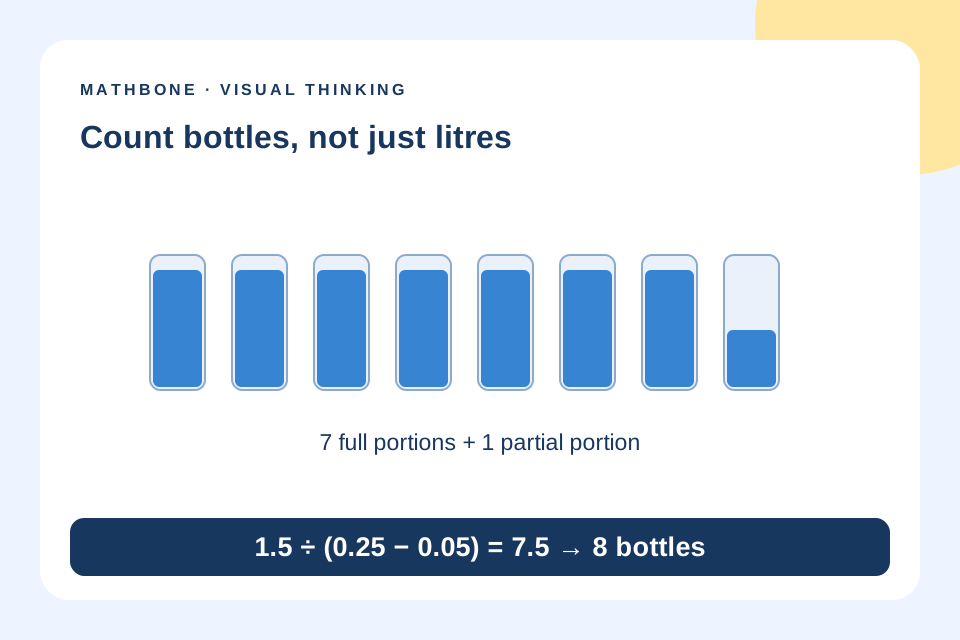
For the extension: each bottle holds 0.20 L. The 1.5 L total needs 7 portions of 0.20 L and a final portion of 0.10 L.
View larger image ↗Upper primary · Decimals and units
Try a more challenging problem
How many 0.25 L bottles hold 1.5 L? If each bottle leaves 0.05 L empty, how many bottles are needed?
Show the worked solution
Full bottles give 1.5 ÷ 0.25 = 6 bottles. Leaving 0.05 L empty means each holds 0.20 L. Then 1.5 ÷ 0.20 = 7.5, requiring at least 8 bottles, with the last partly filled.
Watch this step
The number of bottles available must be a whole number. Interpret 7.5 in context.
Keep exploring together
Choose activities that match the learner’s knowledge and readiness, and discuss what you notice. Explore the curriculum or parent guide below.