The MathBone idea

Deep understanding
builds a foundation for thinking.

The Backbone of Mathematical Thinking — the idea at the heart of MathBone.

Illustrative mathematics learning for MathBone
EXPLORE · CONNECT · EXPLAIN Understand the idea. Take the next step.

Built on understanding

Start small.
Think deeper.

Seeing numbers in groups, noticing patterns and explaining reasoning open different ways to explore mathematics.

This website offers a space to experiment with ideas, try again and ask why through self-guided sample activities.

A journey across 15 levels

MathBone begins at age 4 with Pre Level and progresses through Level 14, from numbers and shapes to algebra, calculus and advanced statistics. Explore topics in each level
The MathBone way · CPA

Explore with real objects.
Think with pictures.
Connect with equations.

CPA means Concrete, Pictorial and Abstract: connecting the same idea through objects, pictures and symbols. Learners can return to pictures or objects whenever they need support.

A learning example How can we think about 8 + 5?

Split 5 into 2 and 3, complete a group of ten, then add what remains.

C CONCRETE

Handle objects and explore

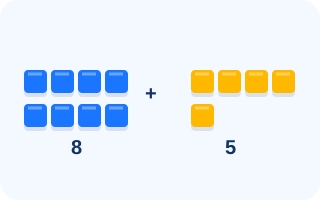
Eight blue counters and five yellow counters representing addition

Arrange 8 counters and 5 more. Move 2 to complete the first group of ten.

The learner arranges, splits and combines the objects.
P PICTORIAL

See relationships in pictures

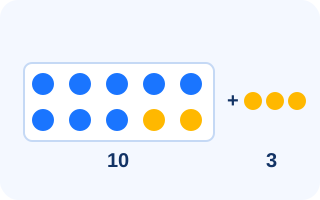
A ten frame with eight blue and two yellow dots, plus three remaining yellow dots

Use a ten frame or number bond to show that 5 splits into 2 and 3 while the total stays the same.

The picture shows the part making ten and the part remaining.
A ABSTRACT

Explain with symbols

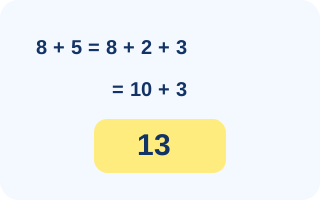
The equation 8 + 5 = 8 + 2 + 3 = 10 + 3 = 13

Write an equation from the experience and explain what each number represents.

8 + 5 = 8 + 2 + 3 = 10 + 3 = 13
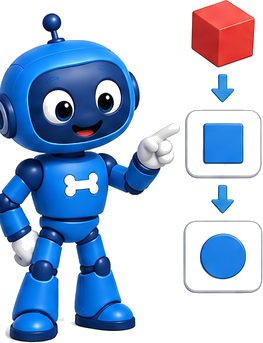
Robo explains the connection between real objects and pictures
Robo invites you to connect what you see

Explain how the counters, pictures and numbers in the same problem are connected.

Apply the idea to a new problem How could the same strategy help with 28 + 5?

CORE Mathematics

Build a structured way of thinking
From understanding to equations

CORE is MathBone’s framework for connecting understanding, observation, representation and symbols within a lesson.

C Concept

Understand the concept

Understand what the numbers and relationships in a problem mean.

O Observe

Observe relationships

Notice similarities, differences, patterns and changes.

R Represent

Represent thinking

Represent ideas with objects, pictures, diagrams, tables or models.

E Equation

Connect with equations.

Use language, numbers and symbols that match the meaning.

Experience · Visualise · Generalise · Apply

Four stages of learning

Experience

Experience a situation

Begin with objects or a problem worth exploring.

Visualise

Visualise the thinking

Choose pictures and models that explain the relationships.

Generalise

Generalise the idea

Explain a rule or strategy based on what was observed.

Apply

Apply to a new problem

Change the numbers or context and apply the existing understanding.

Singapore Math

Problem solving
at the centre of learning.

MathBone uses Singapore Math principles to connect conceptual understanding and calculation skills with problem-solving strategies.

  • Concepts Understand meaning and relationships.
  • Skills Develop fluency and accuracy.
  • Processes Reason, communicate and choose strategies.
  • Attitudes Build confidence, persistence and curiosity.
  • Metacognition Plan, check and adapt strategies.

A connected learning experience

Learning resources and activities
With progress tracking

Resources chosen for the concept

Counters, ten frames, base-ten blocks, fraction strips, cards and cubes work with number bonds, number lines, arrays and bar models.

Activities that extend thinking

Missions, quests and challenges invite learners to build, test and improve, linking mathematics with age-appropriate design tasks and real situations.

Practice and understanding checks

The curriculum includes booklets, workbooks and a CheckPoint every four booklets to review concepts, strategies and application.

Support matched to the learner

Adjust numbers, representations, questions and challenge levels. Use objects or pictures where support is needed and new conditions when learners are ready.

Progress you can understand

What can parents see
in their child’s learning?

Progress tracking considers what a child can do independently, the evidence of that understanding and what to develop next.

Sample progress explanation

Today the learner used a ten frame to add and independently explained the part making ten. Next, they will connect word problems with pictures.

A sample communication format, not a parent testimonial.

Principles behind each lesson

Principles that guide
learning design.

Give learners time to understand, choose and represent their thinking, then practise for fluency and flexibility.

Meaning before method

Start with situations and relationships, then connect them with calculation methods.

Representation before symbols

Use objects, pictures and models as a bridge to numbers and equations.

Thinking before telling

Use questions and thinking time so learners can try strategies, compare them and explain observations.

Practise for transfer

Change numbers or contexts to see whether learners can apply an idea independently.

Problem-solving routine

Six steps for problem solving

  1. Read to understand the situation.
  2. Notice what is known and what needs to be found.
  3. Represent relationships with pictures or models.
  4. Plan and choose a strategy.
  5. Solve systematically.
  6. Check the answer and explain the reasoning.

Connect mathematics with creative work

E-STEAM connects entrepreneurship, science, technology, engineering, arts and mathematics through level-appropriate situations and design tasks. Learners build, test, improve and justify their choices.

FROM QUESTION TO UNDERSTANDING

One idea, explored step by step

The addition example 8 + 5 illustrates connections between objects, pictures and symbols. It is not a fixed lesson schedule.

01

Start with a visible question

Arrange 8 objects and 5 more. Invite learners to consider how to combine them before introducing a procedure.

02

Split and combine

Move 2 from the group of 5 to make ten with 8. Check that 3 remain and that the total has not changed.

03

Draw and write an equation

Use a ten frame or number bond, then write 8 + 5 = 10 + 3 = 13 and explain what each number represents.

04

Apply the idea to a new problem

Try 28 + 5 and discuss how making ten still works, looking for understanding beyond a memorised answer.

YOUR CHILD’S NEXT CHAPTER

Your child’s next chapter
starts with understanding today.

Programs for ages 4 to 18, from Pre Level to Level 14. Find a path suited to understanding and readiness.

Enquire about enrollment Explore the curriculum →