

Secondary
Start with an average rate
On a distance-time graph, divide the change in distance by the change in time between two points to find an average rate, including its unit.
Look at a shorter interval
Bring two points on a curve closer and observe the connecting line. This motivates the idea of slope at a point before a formal derivative definition.
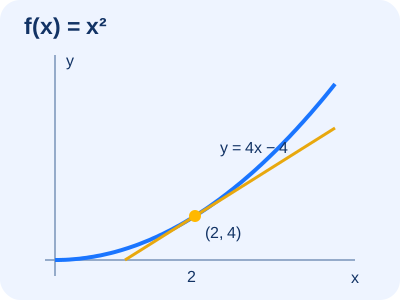
For f(x) = x² at x = 2, the tangent touches at (2, 4) and has slope 4. Connect the point on the curve with the derivative.
View larger image ↗Connect a formula with meaning
For f(x) = x², the derivative is f′(x) = 2x, so the tangent slope at x = 2 is four. Connect the result to the graph and define the variables in any application.
Upper secondary · Derivatives and tangents
Try a more challenging problem
For f(x) = x² − 4x + 3, find the tangent line at x = 3.
Show the worked solution
Differentiate: f′(x) = 2x − 4. At x = 3 the slope is 2 and the point is (3, 0). Thus y − 0 = 2(x − 3), giving y = 2x − 6. Substituting x = 3 returns y = 0.
Watch this step
The derivative gives a slope. The tangent equation also requires a point.
Keep exploring together
Choose activities that match the learner’s knowledge and readiness, and discuss what you notice. Explore the curriculum or parent guide below.