

Primary
Why equal size matters
Draw a pizza circle divided into four equal parts and shade one to show one quarter. Unequal pieces cannot be described just by counting them.
Compare using the same whole
Use equal-sized circles split into halves and quarters. Compare one part from each before explaining why a half is larger than a quarter of the same whole.
Ask for a visual explanation
Ask how they know the parts are equal and what changes when one more part is shaded. Point to the picture before introducing fraction notation.
ONE IDEA · THREE REPRESENTATIONS
Explore one problem through CPA
Explore with objects
Fold one paper circle into 4 equal parts and identify one part.
Represent the relationship
Draw an equal-sized circle split into 4 equal parts and shade one. Compare it with the folded paper.
Connect to mathematical symbols
Write 1/4. Explain that 4 counts the equal parts in one whole and 1 counts the selected parts.
Ask your child to identify how the objects, picture and numbers represent the same quantities. Return to objects or pictures when the connection is unclear.
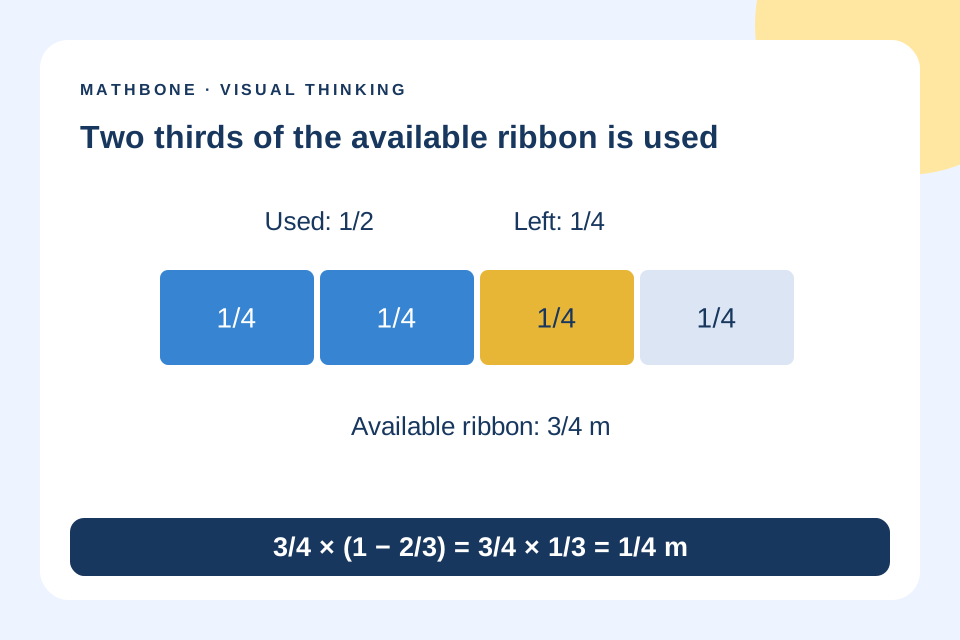
For the extension: the full strip is 1 metre. The available ribbon is 3/4 metre. Using 2 of its 3 quarters uses 1/2 metre and leaves 1/4 metre.
View larger image ↗Upper primary · Multi-step fractions
Try a more challenging problem
A ribbon is 3/4 metre long. Two thirds of it is used. How much remains?
Show the worked solution
Draw one metre, shade 3/4, and divide the shaded region into 3 equal parts. Use 2 and keep 1. The remaining length is (1/3) × (3/4) = 1/4 m. The used length is 1/2 m; check 1/2 + 1/4 = 3/4.
Watch this step
“Of it” refers to the available 3/4 metre, not to a full metre. Do not simply subtract 2/3 from 3/4.
Keep exploring together
Choose activities that match the learner’s knowledge and readiness, and discuss what you notice. Explore the curriculum or parent guide below.