

Secondary
Problem: find x that balances both sides
Given 3(2x − 1) = 4x + 9, find a value of x that gives equal values on both sides. The equals sign expresses a relationship between two expressions.
Expand, then reduce the variable terms
Distribute to obtain 6x − 3 = 4x + 9. Subtract 4x from both sides: 2x − 3 = 9. Add 3 to both sides to get 2x = 12, then divide by 2: x = 6.
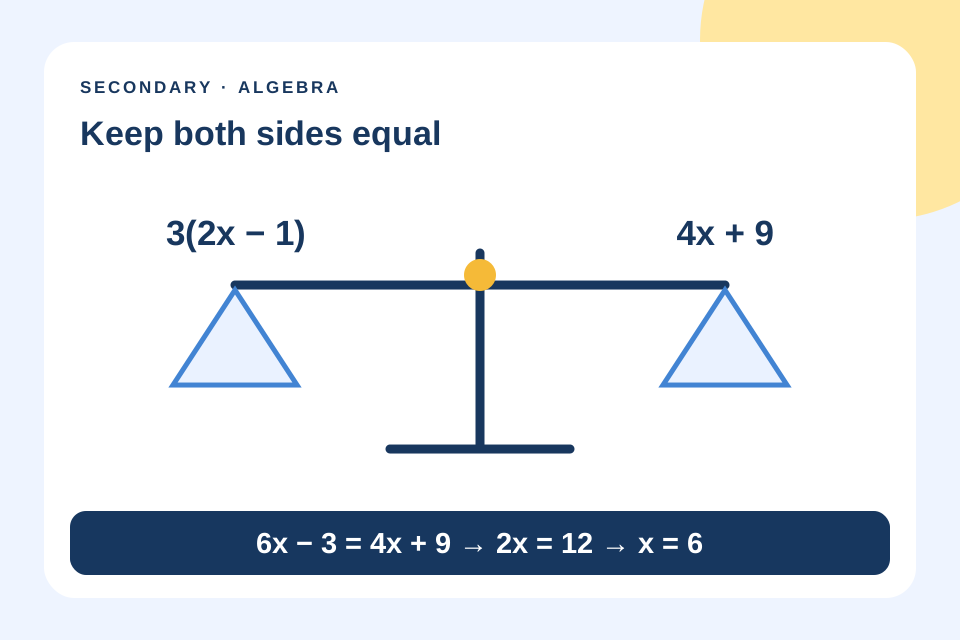
The balance represents equality. Each algebraic operation preserves equality until x = 6.
View larger image ↗Why apply the same operation to both sides?
Imagine a balanced scale. Removing the same quantity from both sides preserves equality. A rule about moving terms is shorthand; learners should explain the operation applied to both sides.
Check and extend
Substitute x = 6: the left side is 3(12 − 1) = 33 and the right side is 24 + 9 = 33. Extend: solve 2(3x + 1) = 5x + 8. Again x = 6; substitution gives 38 on each side.
Keep exploring together
Choose activities that match the learner’s knowledge and readiness, and discuss what you notice. Explore the curriculum or parent guide below.