
Foundations and learning approach
Build a picture of ten
Draw two rows of five spaces and fill seven. Ask how many spaces remain, using the empty spaces to explain the missing three.
Explore 7 + 5
Split five counters into three and two. Move three to complete ten with seven, leaving two: 7 + 5 = 10 + 2 = 12.
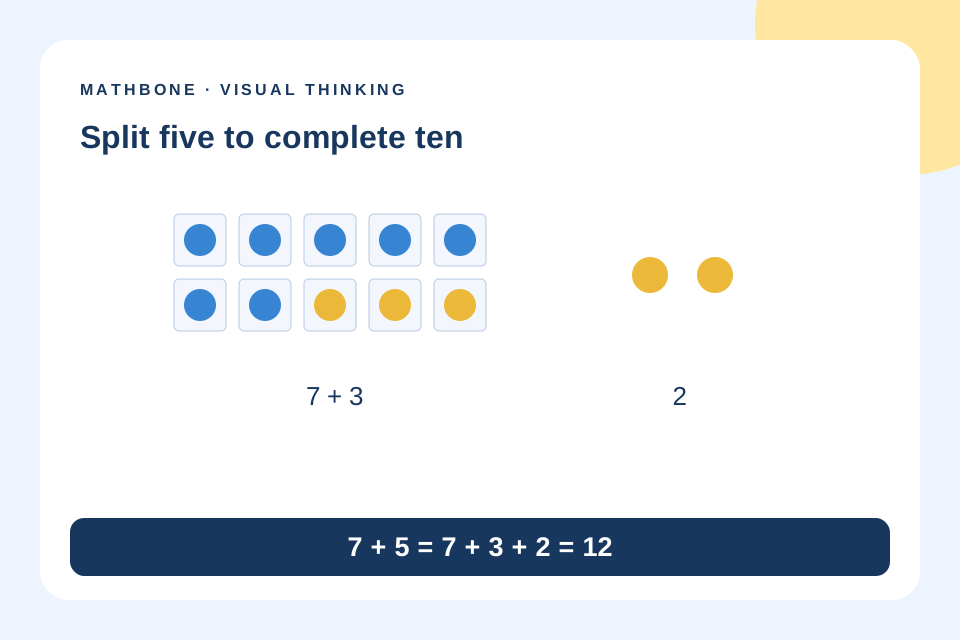
For 7 + 5, split 5 into 3 and 2. Fill the three empty ten-frame spaces and keep the remaining 2.
View larger image ↗Connect the model with an explanation
Ask why three were moved and why the total stayed the same. Change the starting numbers and let the learner choose the missing part.
ONE IDEA · THREE REPRESENTATIONS
Explore one problem through CPA
Explore with objects
Place 8 counters in a ten frame. Use 2 of another 5 counters to fill the empty spaces.
Represent the relationship
Draw 2 rows of 5 cells. Colour 8 in one colour and 2 in another, then draw 3 dots outside.
Connect to mathematical symbols
Record 8 + 5 = 10 + 3 = 13 and explain why rearranging has not changed the total.
Ask your child to identify how the objects, picture and numbers represent the same quantities. Return to objects or pictures when the connection is unclear.
Keep exploring together
Choose activities that match the learner’s knowledge and readiness, and discuss what you notice. Explore the curriculum or parent guide below.