Foundations and learning approach
Start with the whole
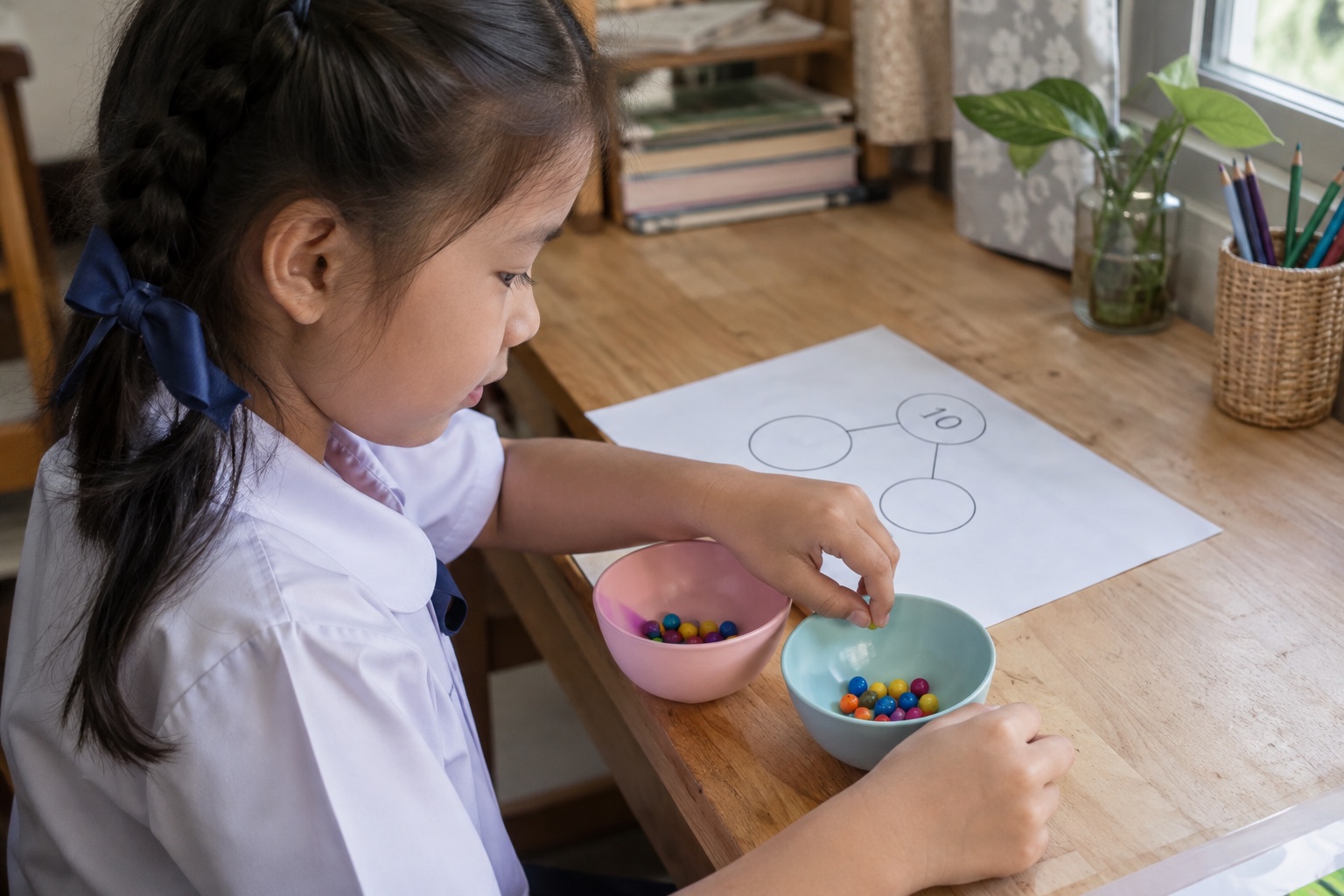
Take eight beads and split them between two bowls, such as five and three. Check that they still total eight and try another split.
Draw the parts and whole
Write eight in a circle linked to circles for five and three. Ask what each circle represents and connect it to the objects.
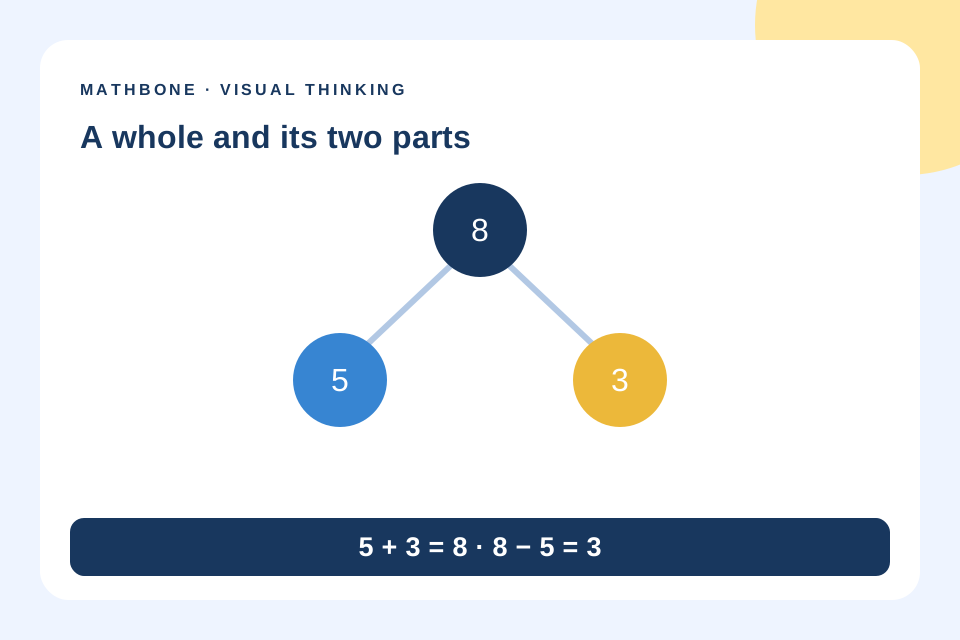
The upper circle is the whole 8; the lower circles are parts 5 and 3. Read the model as addition or a missing-part relationship.
View larger image ↗Read the relationship both ways
If five and three make eight, ask what is missing when the whole is eight and one part is five. The same model supports combining and finding a missing part.
ONE IDEA · THREE REPRESENTATIONS
Explore one problem through CPA
Explore with objects
Split 7 beads into groups of 3 and 4, then combine them to check.
Represent the relationship
Draw a whole of 7 connected to parts of 3 and 4. Clearly identify the whole and the parts.
Connect to mathematical symbols
Connect the model to 3 + 4 = 7 and 7 − 3 = 4, then find another way to split 7.
Ask your child to identify how the objects, picture and numbers represent the same quantities. Return to objects or pictures when the connection is unclear.
Keep exploring together
Choose activities that match the learner’s knowledge and readiness, and discuss what you notice. Explore the curriculum or parent guide below.