

Secondary
Problem: a right triangle with legs 9 and 12
A right triangle has perpendicular sides of 9 cm and 12 cm. Find the hypotenuse and area. The side opposite the right angle is the longest side.
Connect squares with area
Squares on the two perpendicular sides have areas 81 and 144 cm². Pythagoras’ theorem states that their sum equals the area of the square on the hypotenuse.
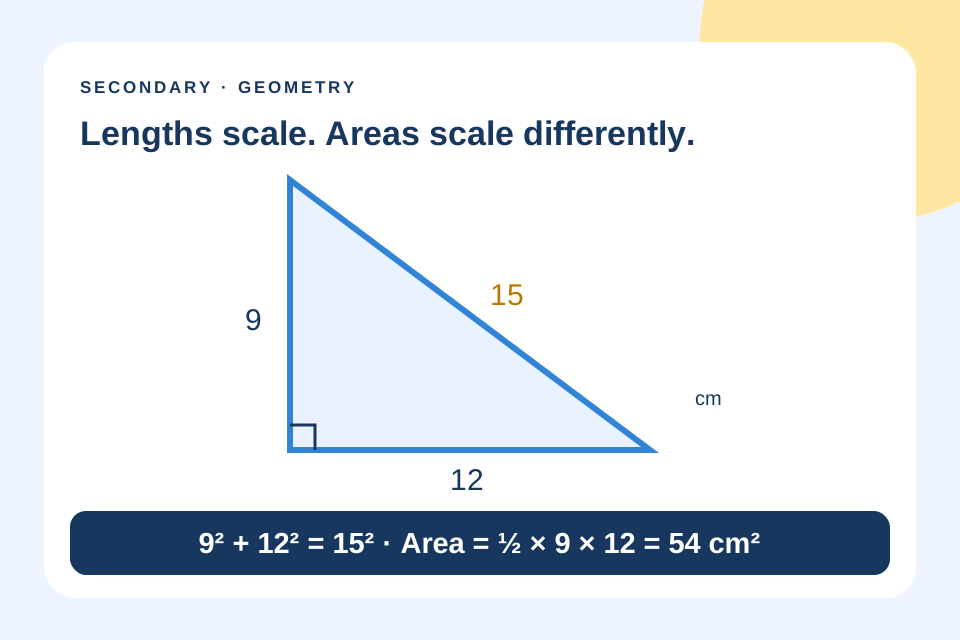
The sides 9 and 12 meet at a right angle, opposite the side 15. The triangle’s area is half the base times the height.
View larger image ↗Calculate the length and area with units
Let c be the hypotenuse. Then c² = 9² + 12² = 225, so c = 15 cm, taking the positive root for a length. The triangle’s area is (1/2) × 9 × 12 = 54 cm².
Extend: how does scaling affect area?
Double every side to 18, 24 and 30 cm. The new area is (1/2) × 18 × 24 = 216 cm², four times the original. Explain why lengths double while area quadruples.
Keep exploring together
Choose activities that match the learner’s knowledge and readiness, and discuss what you notice. Explore the curriculum or parent guide below.