

Secondary
Problem: solve x² − 4x + 3 = 0
Find two numbers whose product is 3 and sum is −4: −1 and −3. Thus x² − 4x + 3 = (x − 1)(x − 3). Expand to check the factors.
Use the zero-product property
If (x − 1)(x − 3) = 0, at least one factor is zero. Hence x − 1 = 0 or x − 3 = 0, so x = 1 or x = 3. These are alternative solutions.
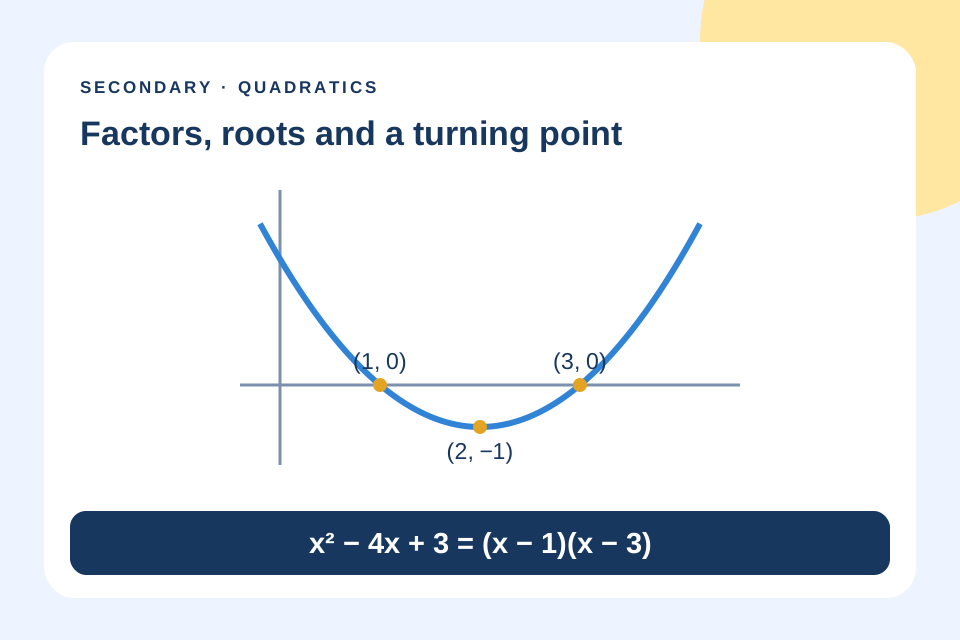
The x-intercepts are (1, 0) and (3, 0). The vertex (2, −1) lies horizontally midway between the roots.
View larger image ↗Where are the solutions on the graph?
The graph y = x² − 4x + 3 crosses the x-axis at (1, 0) and (3, 0), where y = 0. The intercepts therefore match the equation’s roots. Other y-values come from substituting x into the function.
Extend: find the minimum without calculus
Rewrite as y = (x − 2)² − 1. Since a square is non-negative, y ≥ −1, with equality at x = 2. The vertex is (2, −1). Explain its position relative to the two x-intercepts.
Keep exploring together
Choose activities that match the learner’s knowledge and readiness, and discuss what you notice. Explore the curriculum or parent guide below.