
Primary
Name the two quantities
A mixture uses one part concentrate to three parts water. The ratio 1:3 compares concentrate with water, while the total is four parts.
Scale both quantities together
Doubling requires two parts concentrate and six parts water. Adding one part to each quantity would change the proportion.
Check with a model
Use equal-sized cups or a drawing. Ask how many parts of concentrate appear in eight total parts and explain from the model.
ONE IDEA · THREE REPRESENTATIONS
Explore one problem through CPA
Explore with objects
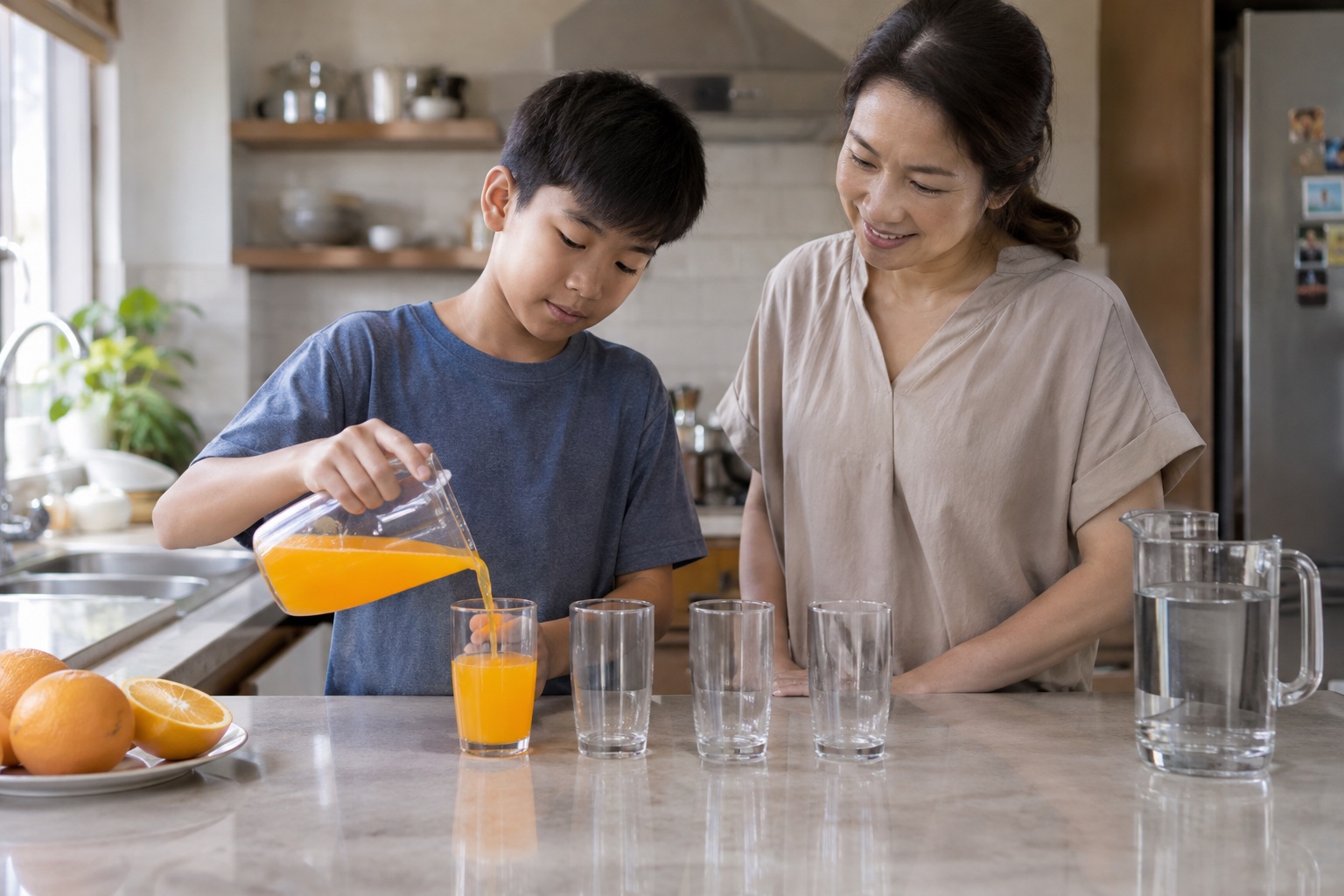
Measure 1 cup of concentrate and 3 cups of water using equal-sized cups.
Represent the relationship
Draw 4 equal units: 1 for concentrate and 3 for water.
Connect to mathematical symbols
Write the ratio 1 : 3. Doubling gives 2 : 6 and a total of 8 cups.
Ask your child to identify how the objects, picture and numbers represent the same quantities. Return to objects or pictures when the connection is unclear.
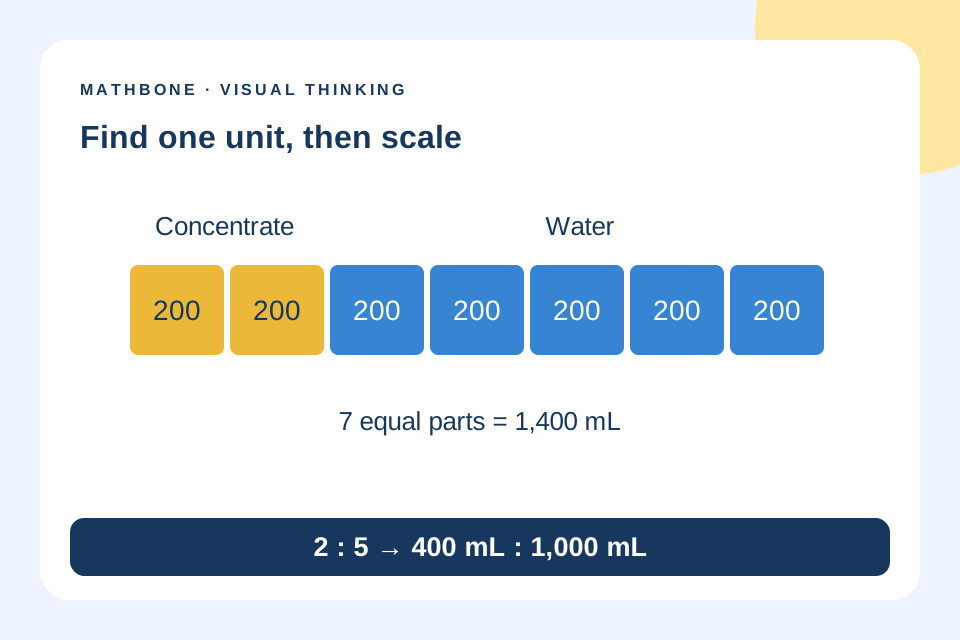
For the extension: a 2 : 5 ratio splits the total into 7 equal parts of 200 mL each.
View larger image ↗Upper primary · Ratios
Try a more challenging problem
Concentrate and water are in the ratio 2 : 5. A mixture totals 1.4 litres. How many millilitres of concentrate are needed?
Show the worked solution
Convert 1.4 L to 1,400 mL. The total is 2 + 5 = 7 parts. Each part is 1,400 ÷ 7 = 200 mL, so concentrate is 400 mL and water is 1,000 mL.
Watch this step
The ratio compares concentrate with water. Concentrate is 2/7 of the total, not 2/5.
Keep exploring together
Choose activities that match the learner’s knowledge and readiness, and discuss what you notice. Explore the curriculum or parent guide below.