
Primary
Retell the situation
Min has eighteen stickers, six more than Palm. How many does Palm have? Retell who has more and identify the difference.
Draw the difference
Draw Min’s bar longer than Palm’s. The extra segment represents six and Min’s total is eighteen, showing Palm has 18 − 6 = 12.
Check against the situation
Substitute twelve for Palm and check that Min has six more. Explain what each part of the model represents.
ONE IDEA · THREE REPRESENTATIONS
Explore one problem through CPA
Explore with objects
Use counters for 12 objects. Give 5 to the first group and find what remains.
Represent the relationship
Draw a whole bar of 12 split into a known part of 5 and an unknown part. The two parts make the whole.
Connect to mathematical symbols
Write 12 − 5 = 7 and check with 5 + 7 = 12. Identify which part of the bar represents 7.
Ask your child to identify how the objects, picture and numbers represent the same quantities. Return to objects or pictures when the connection is unclear.
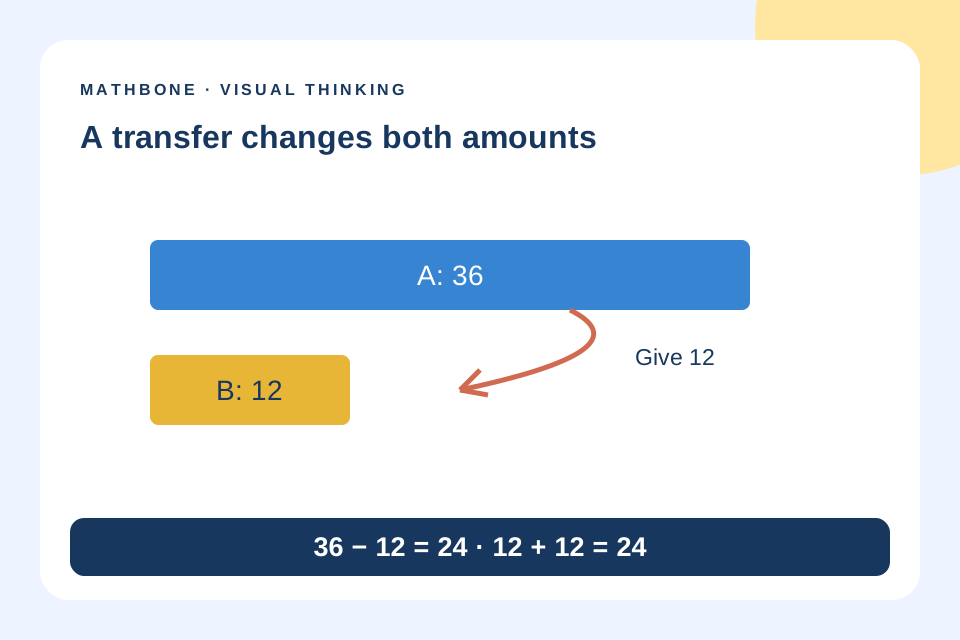
For the extension: A starts with 36 and B with 12. Transferring 12 leaves each with 24 and reduces the original gap by 24.
View larger image ↗Upper primary · Bar models
Try a more challenging problem
A has three times as many stickers as B. After A gives B 12, they have equal amounts. How many did each start with?
Show the worked solution
Draw 3 units for A and 1 for B. The original gap is 2 units. Transferring 12 reduces the gap by 24, so 2 units = 24 and 1 unit = 12. A started with 36 and B with 12; each ends with 24.
Watch this step
A transfer of 12 decreases one amount by 12 and increases the other by 12, closing the gap by 24.
Keep exploring together
Choose activities that match the learner’s knowledge and readiness, and discuss what you notice. Explore the curriculum or parent guide below.