
Connected foundations
Topics progress from matching and counting to arithmetic, fractions, algebra and calculus, connecting new ideas with previous learning.
THE BACKBONE OF MATHEMATICAL THINKING
Mathematics programs for ages 4 to 18 years
Build a strong foundation from Pre Level to Level 14
 Let’s explore with Robo ↗ Try a learning experience ↗

A STRONG FOUNDATION. A CURIOUS MIND.
From numbers and shapes to more complex problems, explore the curriculum, learning approach and examples that suit the learner.
WHY MATHBONE
From early activities to more complex problems, MathBone focuses on understanding, reasoning and application.

Topics progress from matching and counting to arithmetic, fractions, algebra and calculus, connecting new ideas with previous learning.
Counters, ten frames, fraction strips and models reveal relationships before connecting them to numbers and equations through CPA.
Missions invite learners to arrange, rotate, observe and plan, trying their own strategies and using hints when needed.
Learners explain their thinking, compare strategies and check whether an answer makes sense in context.
Practice, activities and checkpoints help identify independent understanding and skills that need further practice.
ROBO · MATHBONE Your curious companion
A little companion who invites you to try, observe and explain. Explore numbers and shapes, and discover your own way of thinking.
The MathBone way · CPA
CPA means Concrete, Pictorial and Abstract: connecting the same idea through objects, pictures and symbols. Learners can return to pictures or objects whenever they need support.
Split 5 into 2 and 3, complete a group of ten, then add what remains.
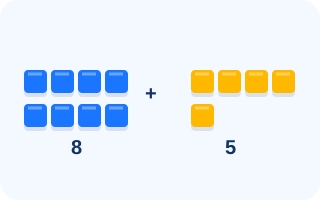
Arrange 8 counters and 5 more. Move 2 to complete the first group of ten.
The learner arranges, splits and combines the objects.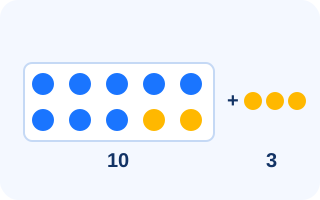
Use a ten frame or number bond to show that 5 splits into 2 and 3 while the total stays the same.
The picture shows the part making ten and the part remaining.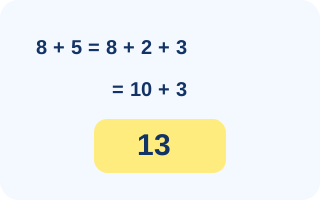
Write an equation from the experience and explain what each number represents.
8 + 5 = 8 + 2 + 3 = 10 + 3 = 13
Explain how the counters, pictures and numbers in the same problem are connected.
Discover · Play · Understand
Begin with what you can see, connect it to an idea and apply it to a new problem. Explore at your own pace.
 All 5 missions explored!
Explain the ideas in your own words, then discover what you could explore next at MathBone.
Explore the curriculumSample website activities. No account needed. Progress lasts only while this page stays open.
Little discoveries. Lasting foundations.
Explore numbers, investigate shapes and explain your reasoning. Small questions lead to ideas that grow.
Arrange, split and combine. Connect the models you see with equations you understand.
Explore numbers ↗ Explore by seeingRotate, reflect and compare. Explore relationships between positions and shapes.
Explore shapes ↗ Explore by reasoningPlan a path, test the conditions and explain why you chose that approach.
Explore reasoning ↗Every age. A new possibility.
For learners aged 4 to 18, with 15 progressive levels. Choose a starting point based on understanding and readiness.

Matching, counting, shapes and patterns through hands-on exploration and meaningful pictures.

Connect numbers with calculation, use models to solve problems, and explore fractions, decimals and ratios.

Algebra, graphs, functions and advanced mathematics leading to calculus and data analysis.
Ages are a guide. Learners with an existing foundation can start at a level suited to their readiness.
For growing minds
For ages 13 to 18, Levels 9 to 14 connect algebra, geometry, functions and advanced mathematics, helping learners choose strategies and explain reasoning.
 FROM IDEAS TO REASONING
A glimpse of the mathematics
Examples of topics for older learners. Explore the diagrams, ask questions and reveal each explanation.
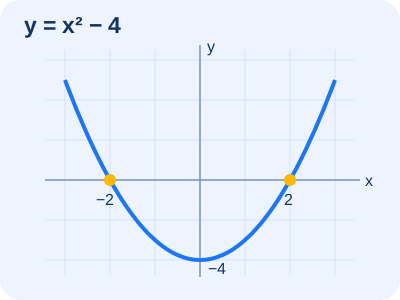
Where does y = x² − 4 cross the x-axis?
Set y = 0 to get x² = 4. Then x = −2 or 2, so the intercepts are (−2, 0) and (2, 0).
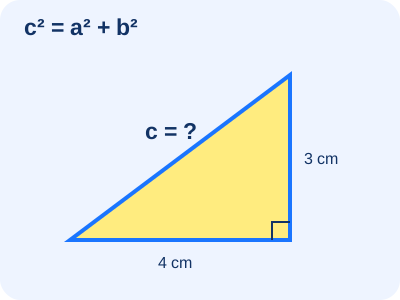
A right triangle has legs of 3 cm and 4 cm. How long is the hypotenuse?
By Pythagoras, c² = 3² + 4² = 25. Length is positive, so c = 5 cm.
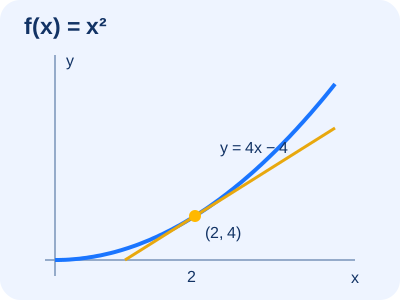
If f(x) = x², what is the tangent slope at x = 2?
The derivative is f′(x) = 2x. At x = 2, f′(2) = 4, so the slope is 4.
YOUR FIRST STEPS
Choose a starting point based on readiness and discuss learning goals and practical details with the team.
Share age, school year, current topics and areas where support is needed, such as number understanding, word problems or explaining reasoning.
Read the Pre Level to Level 14 topics and note familiar areas and practice needs. Ages are guidance, not placement rules.
Ask the team about centres, schedules, fees, session counts and course terms to find a suitable arrangement.
Curiosity, on paper
MATHBONE JOURNAL
Explore primary fractions and ratios, then secondary equations, graphs, geometry and probability, with worked steps and explanations.
Articles 1 to 3 of 26
View all articles ↗Upper primary · Fractions
Start with equal parts, then solve a multi-step problem and identify the whole at each step.
Read article ↗Lower secondary · Simultaneous equations
Understand the intersection before eliminating a variable.
Read article ↗
Lower secondary · Quadratics
Connect x² − 4x + 3 with its factors, intercepts and minimum.
Read article ↗Singapore Math · CPA
Connect three representations of one idea with a practical 8 + 5 example.
Read article ↗
The CPA approach
Connect everyday objects, drawings and a short equation to the same idea.
Read article ↗
Numbers and addition
Use a ten frame to see a missing part before connecting it to addition.
Read article ↗
Thinking with models
Connect parts with the whole through objects and a simple diagram.
Read article ↗
Upper primary · Multi-step problems
When one amount falls and the other rises, how does the gap change? Model it before calculating.
Read article ↗
Multiplication
Arrange equal groups and connect them with multiplication.
Read article ↗
Upper primary · Ratios and units
Connect a ratio, fractions of a total and litre-to-millilitre conversion in one problem.
Read article ↗
Curriculum
Age offers a guide; prior knowledge and readiness make the conversation more useful.
Read article ↗
Shapes and reasoning
Explore position, comparison and change through a short visual game.
Read article ↗
Mathematics for older learners
Connect a simple situation with words, variables and a graph before increasing complexity.
Read article ↗
For parents
Use a difficult moment for reflection while keeping the thinking with your child.
Read article ↗Early learning
Match objects one by one and explore what the final count means.
Read article ↗
Patterns
Explore colours and shapes before connecting to number patterns.
Read article ↗
Measurement
Length is a distance, not just the number beside an object’s end.
Read article ↗
Time
Use a clock and timeline to explore starting times and elapsed time.
Read article ↗
Everyday mathematics
Connect prices, payment and differences through pretend play.
Read article ↗
Upper primary · Decimals
Calculate capacity with decimals, then interpret the result as a whole number of bottles.
Read article ↗
Graphs and data
Check units, range and scale before drawing a conclusion.
Read article ↗
Advanced mathematics
Connect a graph, its slope and a rate of change.
Read article ↗
Lower secondary · Equations
Connect a balance model with expanding brackets and checking by substitution.
Read article ↗
Lower secondary · Geometry
Identify the hypotenuse before applying a² + b² = c².
Read article ↗
Lower secondary · Probability
Use a tree diagram to follow outcomes and multiply along a path.
Read article ↗
Lower secondary · Statistics
Use one data set to see how an unusually large value affects summaries.
Read article ↗Scroll right for more articles, or use the arrow buttons
No. The curriculum begins at Pre Level, but the starting point should reflect prior knowledge and readiness. Discuss level selection with the team.
Alongside answers, learners can practise reasoning, modelling, comparing methods and solving problems with new conditions at their level.
Start with familiar ideas, use pictures or objects and gradually add complexity. Tell the team which areas are independent and which need support.
No. The 48 core booklets describe curriculum materials per level. Session counts and teaching hours depend on the offered course.
Math Lab offers sample activities for exploring ideas. It is not a placement test or a formal learning assessment.
Use the MathBone contact form with the learner’s age and preferred area. The team can respond with relevant course details.
Programs for ages 4 to 18, from Pre Level to Level 14. Find a path suited to understanding and readiness.